Custom Software Development9 min read
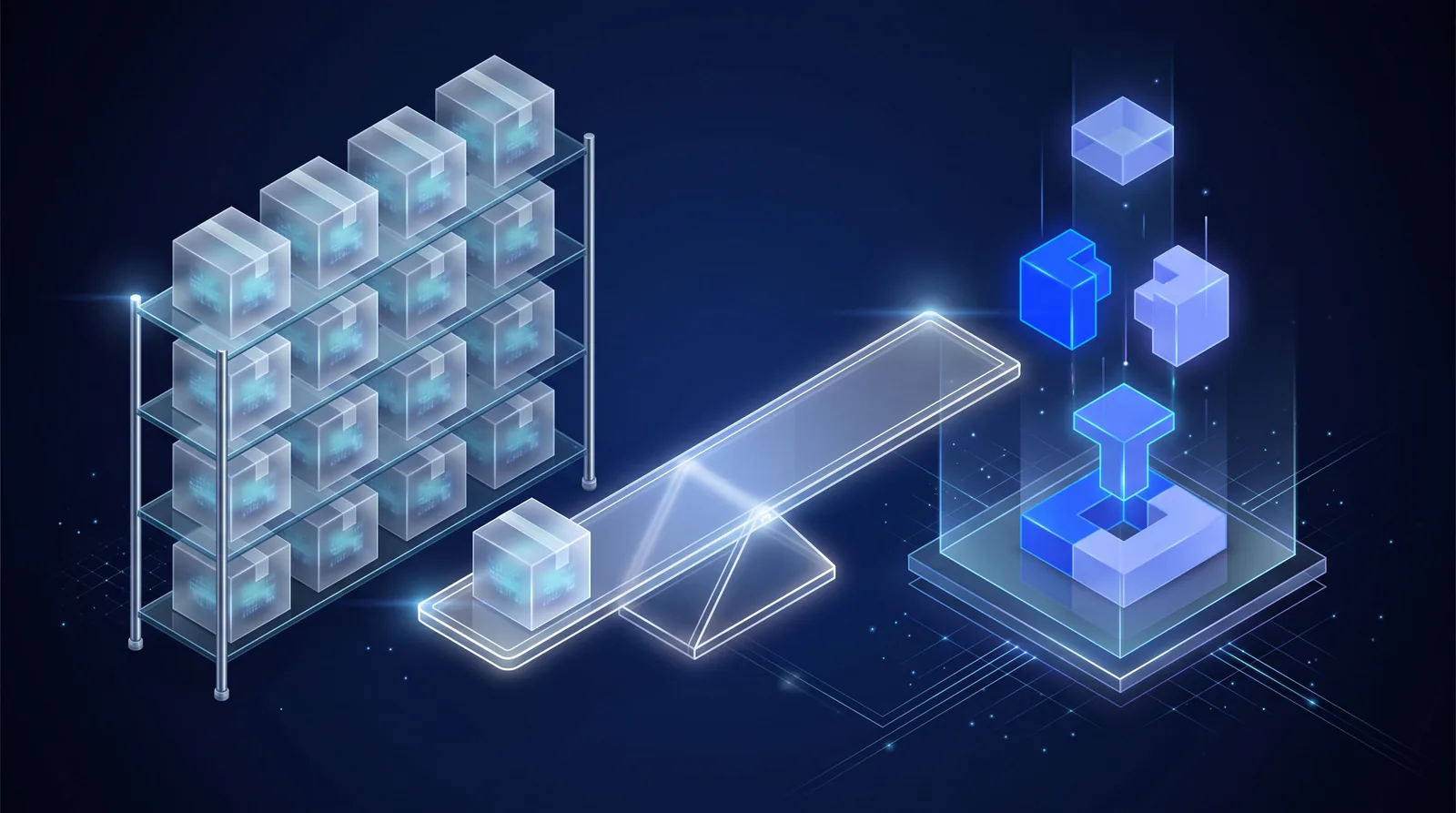
Custom software vs off the shelf is usually framed as a choice between paying more for a perfect fit and paying less for something standard. In practice most organisations need both. Payroll, accounting, email and document storage work much the same in every business, and buying them is almost always right. The process that makes your organisation different, or the one that has to join five systems together, is where a custom build earns its cost.
Our advice is to buy off the shelf whenever a product fits the process with configuration alone, and to build only where no product fits without heavy customisation, where the process is part of how you compete, or where the work is connecting systems that were never designed to talk. Compare the two over five years, not the first year, because subscription prices have been rising far faster than inflation and custom software has running costs too. Check who controls your data and how you would leave before you sign either way. We build custom software, and we still recommend buying more often than building.
When off the shelf software is the right answer
Off the shelf software wins when the process is common, the product is mature and your way of working is not what makes you different. You get years of other customers' feedback, a vendor responsible for security and compliance updates, and a system that works next week rather than next quarter. We would buy rather than build in these cases:
- Accounting, payroll and tax, where the rules change every year and vendors keep up with the ATO
- Email, calendars, file storage and video calls
- Standard CRM, help desk and HR processes that you are willing to run the vendor's way
- Anything you need working within weeks, with no budget for a discovery
- Processes where an industry product already serves dozens of organisations like yours
The honest test is whether you can adopt the product's process. If you would change a few habits to fit it, buy it. If you would need to customise it so heavily that upgrades become risky, you are building custom software on someone else's platform, with their price rises attached.
When custom software is worth building
Custom software earns its cost when the process is specific to you and valuable to get right. Typical signs are staff working around a product with spreadsheets, the same data entered into three systems, a process that is part of what customers choose you for, or rules that no product models properly. It also makes sense when the work is mostly integration: a platform that sits between your ERP, your finance system and your field staff and makes them behave as one.
Building has costs a subscription hides. You fund the build, the hosting, security updates and ongoing changes, and you need a partner or team who will be there in five years. Our guide to custom software cost explains what drives the build, and agentic development has reduced it considerably. Ownership is the other condition. Make sure the contract assigns the copyright to you, as our guide to choosing a software development company explains, or you have bought a licence rather than an asset.
Compare the cost over five years, not the first year
Subscription prices are not fixed, and they have been rising much faster than inflation. Vertice, which tracks software spending, measured software as a service (SaaS) inflation at between 12.7 and 16.4 percent a year in mid 2026, while Australian consumer prices rose about 4 percent. Vertice sells software procurement services and its data is global, so read it as a direction rather than a forecast for your contracts.
- SaaS inflation, June 202616.4%
- SaaS inflation, September 2026 (early data)14.3%
- Australian CPI, June 20263.8%
- Australian CPI, September 20264.3%
Sources: Vertice SaaS inflation rate, October 2026, global data; Australian Bureau of Statistics, consumer price index, 28 October 2026.
Individual vendors show the same pattern. These rises applied worldwide, Australia included, in the last eighteen months, though local prices vary.
| Vendor | Change | Effective |
|---|---|---|
| Microsoft 365 | Commercial suites up worldwide, for example Business Basic from US$6 to US$7 and Business Standard from US$12.50 to US$14 per user per month | 1 July 2026 |
| Salesforce | Enterprise and Unlimited editions of Sales, Service and Field Service up 6 percent on average | 1 August 2025 |
| Atlassian Cloud | Jira and Confluence Standard up 5 percent, Premium 7.5 percent and Enterprise 7.5 to 10 percent | 15 October 2025 |
The sources are Microsoft, Salesforce and Atlassian's pricing notice. Unused seats add to the bill. Zylo's 2026 SaaS Management Index found that organisations leave an average of 36 percent of their SaaS licences unused, though Zylo sells software to manage exactly that. When you compare options, model five years of subscriptions with a realistic yearly increase and the seats you will really use, against the build, hosting and support of the custom option.
Tax treatment differs too. The ATO treats SaaS subscription fees as operating expenses deductible in the year you pay them. In house software you develop or have developed is written off over five years if you started to hold it on or after 1 July 2015, or through a software development pool at nothing in the first year, then 30, 30, 30 and 10 percent. Ask your accountant how each option affects your cash flow.
Check who controls your data and how you would leave
With a product, ask where the data is stored and what happens when you stop paying. Many large vendors now offer Australian storage. Microsoft sells Advanced Data Residency as a paid extra, with Australia as an eligible region, and Atlassian lets eligible plans pin data to its Sydney region. When a Microsoft 365 subscription ends, Microsoft keeps the data for 90 days for you to extract and deletes it within 180. Check the equivalent terms for every product you rely on, and test an export before you need one.
With a build, control comes from the contract and the accounts. Your organisation should own the copyright, the code repository and the cloud subscription, so another firm could take the system over if it had to. Ask for documentation and a handover plan as part of the build, not as an extra at the end.
The mix most organisations end up with
The usual answer is a mix. Buy the platforms that are the same everywhere, such as Microsoft 365, your ERP and your accounting system, and build the thin layer that is yours: the integration between them, the customer or staff portal, and the workflow that carries your particular rules. That keeps the custom part small, so it is cheaper to build and support, and it lets the products do what they do well.
Government follows the same logic in its own rules. The Digital Transformation Agency's Consider First policy requires Commonwealth agencies to consider existing options before sourcing, building or reusing a digital product worth $80,000 or more, and criterion 6 of the Digital Service Standard is titled Don't reinvent the wheel. Private organisations would do well to apply the same discipline.
What we would do
List the processes the decision covers and mark each as standard or distinctive. Look hard for a product for every standard one, and trial the best two with real data and real staff before you decide it does not fit. For the distinctive processes, and for the joins between systems, get a short discovery and a range for a custom build.
Then compare the options over five years, including price rises, unused seats, support and the cost of leaving. Choose the product where it fits, build where it does not, and make sure you control your data and your code either way. Our custom software development team is happy to help you draw the line.